
Catoosa Projected Versus Actual Release
A projected date is an estimate or calculated endpoint. An actual release date records the event after the person leaves a custodian. The distinction matters in Catoosa County because county-jail, state-prison, parole, and transfer records use different date labels. A person can also leave Catoosa County Jail for another agency, so departure from the jail does not always mean community release.
A pretrial detainee has not begun a final sentence for the pending charge. Bond, a court order, dismissal, holds, or transfer controls the next move. Catoosa states that there is no set out-processing time after bond is posted. Safety, jail traffic, movement, and established processes affect timing. Even a valid bond does not clear a separate hold.
A scheduled or tentative date is not an actual exit. Confirm the status after the event with the jail, GDC, Parole Board, or receiving agency.
- MRD
- Maximum Release Date, the date a GDC inmate would leave if the full sentence were served without a parole decision.
- TPM
- Tentative Parole Month, the planned month for final Parole Board review.
- Earned time
- A county-sentence allowance that can reduce time served under Georgia law.
- PIC
- Performance Incentive Credit for an eligible GDC offender's progress, work, and conduct.
Find Catoosa Release Dates
First identify whether the person is a pretrial county detainee, a sentenced county inmate, or a GDC state prisoner. The same name can appear in a Catoosa jail record and later in a state record, but each agency describes its own custody period.
- Check the Catoosa Zuercher portal for current custody and any release-date field. A null release date often aligns with current custody, while a timestamp may mark departure.
- For a county sentence, compare the booking record with the Catoosa court disposition. Ask Sheriff's Records how earned time was applied when exact confirmation is needed.
- For state prison, use the GDC Find an Offender explainer and the official query. Read the location, status, release date, MRD, and sentence data carefully.
- Use the Parole Board TPM Lookup when a TPM is at issue. A TPM does not guarantee release.
- Verify a disputed state record in writing with GDC Inmate Records and Information.
The Catoosa County release-record path covers booking sheets and court dispositions when a public roster is not enough. GDC tells users that public search data must be checked by written correspondence with Inmate Records and Information at PO Box 1529, Forsyth, GA 31029.
Catoosa County Earned Time
O.C.G.A. § 42-4-7 governs the core county-inmate rule. It requires inmate records and states that a county inmate sentenced to confinement is released at sentence expiration less earned-time allowances. The statute does not turn every Catoosa jail booking into a projected sentence date. It applies to a sentenced county inmate, and the sheriff or jail records must show how the calculation was used in the individual case.
Bond release follows another path. Catoosa permits property bond, an approved bonding-company bond, or exact-change cash bond when a bond exists and no other charges or holds block release. Posting bond does not create an earned-time date. It starts local processing, which has no set completion time under the sheriff's published information.
Court changes can alter county calculations. An amended sentence, newly credited jail days, a revocation, or a correction may change the expected endpoint. Compare the court order to the jail record. If they differ, ask the office that entered the contested date to reconcile it.
Catoosa GDC Release Calculations
State-prison time is calculated in the GDC and Parole Board framework, not under the county-jail rule alone. Georgia regulations define MRD and TPM separately. MRD assumes service of the sentence without parole. TPM is a Board planning month for final parole review. A parole release date is set only after the Board completes the relevant review and decides release is appropriate.
The GDC Performance Incentive Credit program can affect eligible state offenders. Satisfactory progress in programs, work assignments, and behavior can earn up to twelve points, with a potential one-to-twelve-month reduction in TPM or MRD. GDC excludes death sentences, sentences of two years or less, non-parole-eligible or minimum-mandatory cases, and life sentences from that program.
The GDC release-date information shown below comes from the agency's questions about loved ones page.
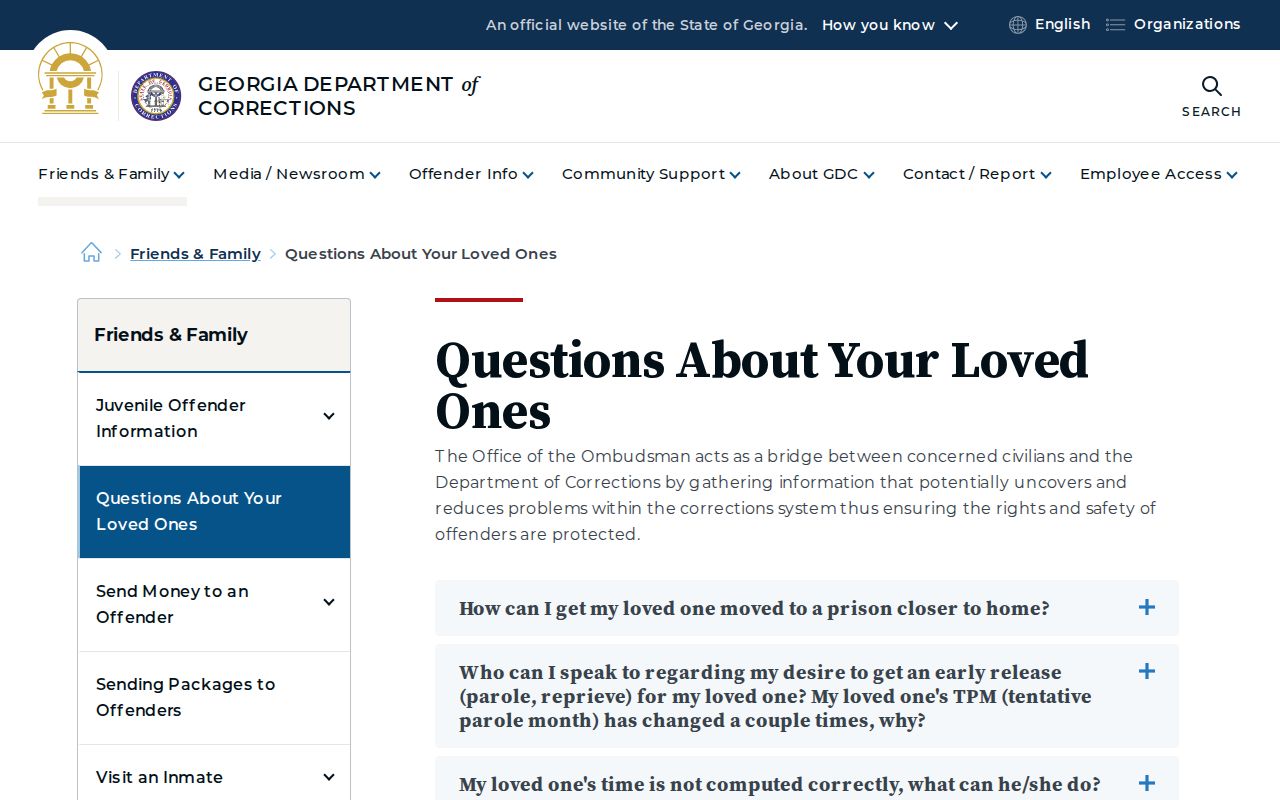
The screen points readers to state-prison information, but a Catoosa county-jail-only detainee should remain in the sheriff and court channels.
Catoosa Release Date Changes
No single cause explains every change. The record should identify the agency and type of date before two values are compared.
| Factor | Possible effect | Record to check |
|---|---|---|
| County jail credit | May reduce a county sentence endpoint | Sheriff record and court disposition |
| Amended court order | Can alter sentence length or credit | Catoosa court docket |
| PIC progress | May reduce an eligible GDC TPM or MRD | GDC record |
| Discipline or conduct | May affect credit or a parole decision | GDC and Board records |
| Parole review | May set, change, withhold, or deny parole | Parole Board tools |
| Detainer or hold | Can block community release or cause transfer | Jail, GDC, ICE, federal, or other agency record |
| Data correction | May replace an erroneous public date | Agency that created the date |
Transport logistics can affect the actual exit even when the calculated date does not change. Catoosa's local no-set-time policy is the clearest example. A public portal may also update after movement occurs, so an expected date should be checked again after the scheduled event.
Catoosa Mandatory Sentence Limits
Georgia does not have one blanket rule that every person serves eighty-five percent of every sentence. Serious violent felony and minimum-mandatory rules depend on the offense and judgment. O.C.G.A. § 17-10-6.1 is a key serious violent felony statute, but it must be applied to the actual offense and sentence.
GDC also identifies non-parole-eligible and minimum-mandatory offenders as outside normal PIC treatment. That is why a generic percentage cannot replace a case record. Review the judgment, sentence, offense statute, GDC calculation, and Board information. If jail credit appears wrong, GDC advises the inmate to speak with a counselor and may require contact with the clerk in the county of conviction.
Confirm Catoosa Actual Release
After the projected day arrives, return to the custody system. A county record should show a release timestamp or the Sheriff's Records Division can provide booking and release confirmation. A GDC record should reflect the state event, with written verification available through Inmate Records. A parolee may then appear in the Board's Parolee Search and be supervised by DCS.
Register through the Catoosa VINELink inmate search when notice of a participating custody change would help. VINELink is an alert layer. It does not certify the court disposition, sentence computation, or transfer destination.
Check ICE ODLS or BOP when a record names an immigration or federal hold. Catoosa's published detainer activity makes this more than a remote possibility. A local exit can be a transfer date.
Note: Use the exact label shown in the source record; MRD, TPM, projected release, parole date, and actual release are not interchangeable.
County and GDC Systems
Catoosa County earned time and GDC PIC are separate systems. The county statute reduces a sentenced county inmate's term by earned-time allowances. The state PIC program may reduce an eligible state offender's TPM or MRD based on specified progress and conduct. Neither process promises the hour a person will leave a facility.
This distinction also prevents a common search error. A Catoosa arrest does not itself make someone a GDC offender. Use GDC only when a state sentence or transfer supports that route. For a local sentence, keep the calculation with the sheriff and court.
Catoosa Release Record Reconciliation
When two projected dates differ, preserve both labels and source dates. A court sentence may be older than a later jail-credit calculation. A GDC record can change after a corrected sentence, PIC award, or Board action. Ask the clerk about the judgment, the sheriff about a county calculation, and GDC about a state calculation.
Formal proof may need more than a screenshot. Catoosa GovQA can provide a booking sheet and release confirmation. The Clerk can provide a certified disposition. GDC requires written verification of public offender data. Those records can show why the estimate changed and which date became controlling.
Do not subtract days from a sentence and present the result as official. Jail credit, sentence structure, mandatory terms, parole rules, and agency calculations can change the answer. A personal estimate is useful only for spotting a question to raise with the clerk, sheriff, counselor, GDC, or Board.
Also distinguish a release estimate from transport. A person may reach a lawful release point yet remain briefly in process, or may leave one facility for another custodian. The final record should show both the date and the status that followed.
When requesting correction, quote the precise field at issue and attach the order or record that supports the question. Ask the agency to explain whether the displayed value is scheduled, maximum, tentative, or actual. That focused approach avoids replacing one unclear date with another and creates a traceable answer for the Catoosa case.